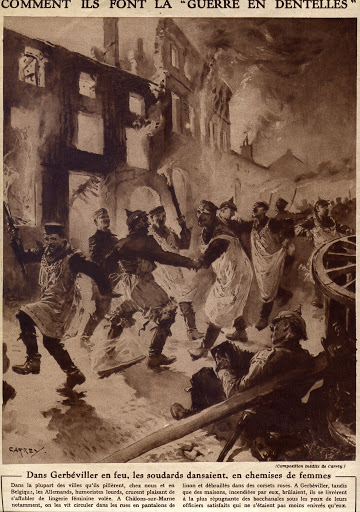
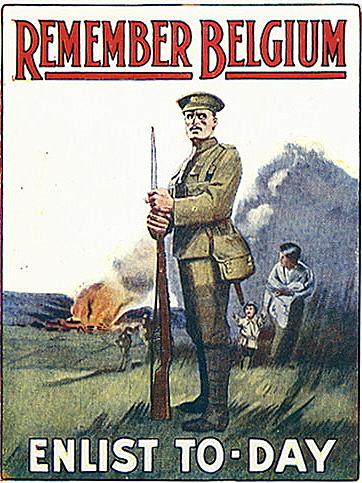
Meanwhile over the decades the railways develop and the posh hotspot Waulsort thrives three a half kilometer upstream of Freyr. Newspapers of that time report
protests against car congestion on Sunday as cardrivers take the cycle lane without batting an eyelid.
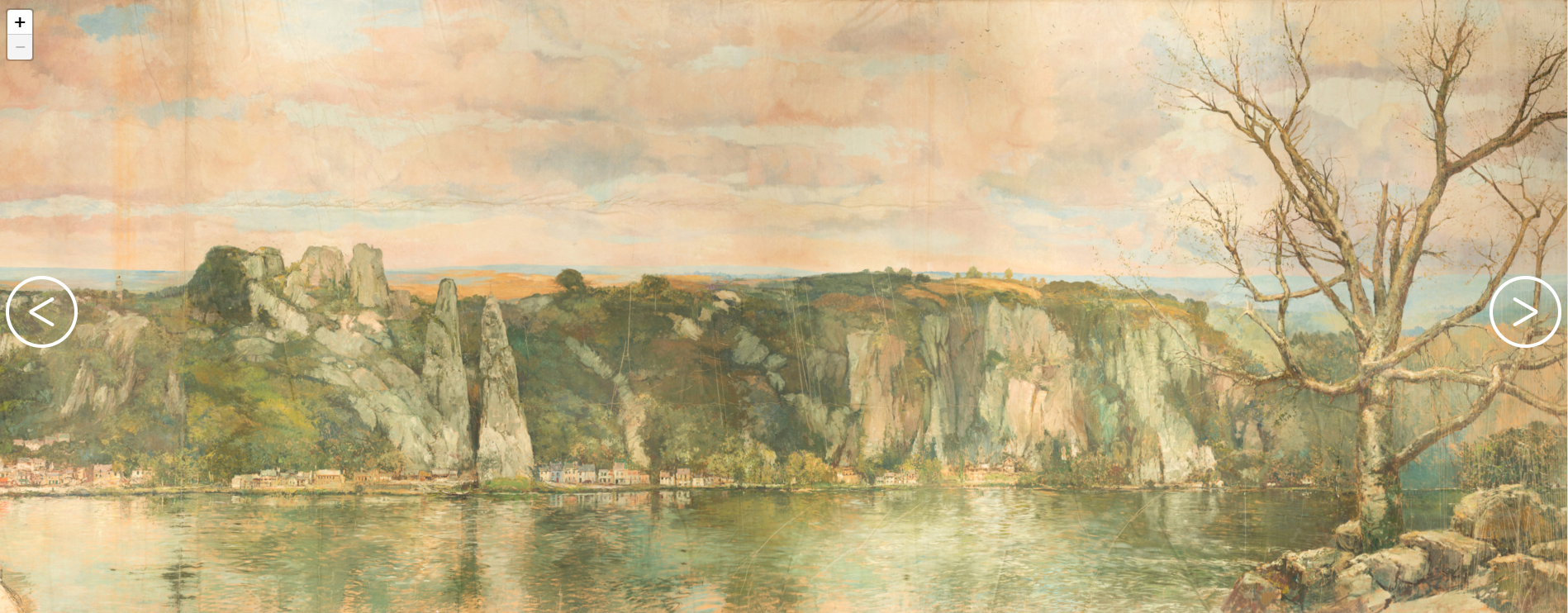
Some rich and famous gradually try climbing opportunities nearby. First ‘La Chandelle de Chaleux’ sees the light along the Lesse river. Then follows the ‘Rocher Bayard’ in Dinant and subsequently ‘La Chamia’ and ‘La Longariesse’ in Waulsort, ‘La fissure Grunne’ in Dave and thereafter the Ourthe is explored in Sy and Hotton, followed by Yvoir and Grands Malades. For this the count Xavier de Grunne often negotiates rock access with aristocratic land and castle owners.
In 1930 36-year-old Xavier de Grunne dares his way up the intimidating rocks of Freyr. He manages to open the first route with mountain boots, a bit of metal and assumably static hemp rope. Route 'de Grunne' runs up the corner between Tête du Lion and Le Pape. Xavier later voluntarily picks up the weapons against the Germans, again. It will be his death in 1944 in a concentration camp in present-day Poland. He leaves six children behind.
After the Tête du Lion / Pape massif, the second to be explored is Mérinos. There two routes are established. Then in 1931 the Aiguille de la Jeunesse is climbed by Camille Fontaine. During this year several climbers try to make it up the yet unclimbed major massif, Al'lègne. King Albert I explores and Xavier de Grunne will really work out a way up. An interesting book in this light is the Dutch 'Speeltuin Van de Koningen' featuring this picture of King Albert I on top of Mérinos.
Freyr is often associated with king Albert I, the relatively popular Belgian king who had, just more than a decade earlier, tried to keep morale high during the unseen violent outbreak of political strive and confusion escalating into World War I (and into his needed command in Flanders' Fields). Later, by the beginning of the 1930's, the king is part of a select club of adventurers with time, money and desire more than fear for Freyr. Albert I is accompanied by a French guide, several club companions and/or his son (later king Leopold III, no first or second degree family to the dreaded genocidist and despot Leopold II). Albert I dies four years after Freyr's first route, on a winter's day, 59 years old, on the rocks of Marche-les-Dames. Though at that moment Albert is the first honorary president of the UIAA (today's world federation) the Belgian people don't know about his alpinism 'till that catastrophic day is cried out by all headlines. Reading about Freyr, king Albert I often pops up, with writings consistently being covered under a film of royal praise. These texts require critical reading. In the climbing community lives the persistent assumption that Xavier's rope partner in Freyr's first route is King Albert I. This is not confirmed by any of the major sources of that time. Though Albert and Xavier do climb together on the Cathedral in Sy.
By 1934 Freyr has 9 routes. In 1935 Bleausard and alpinist Pierre Allain visits with some French friends. In 1937 the newspapers announce the first ascent of Le Pape.
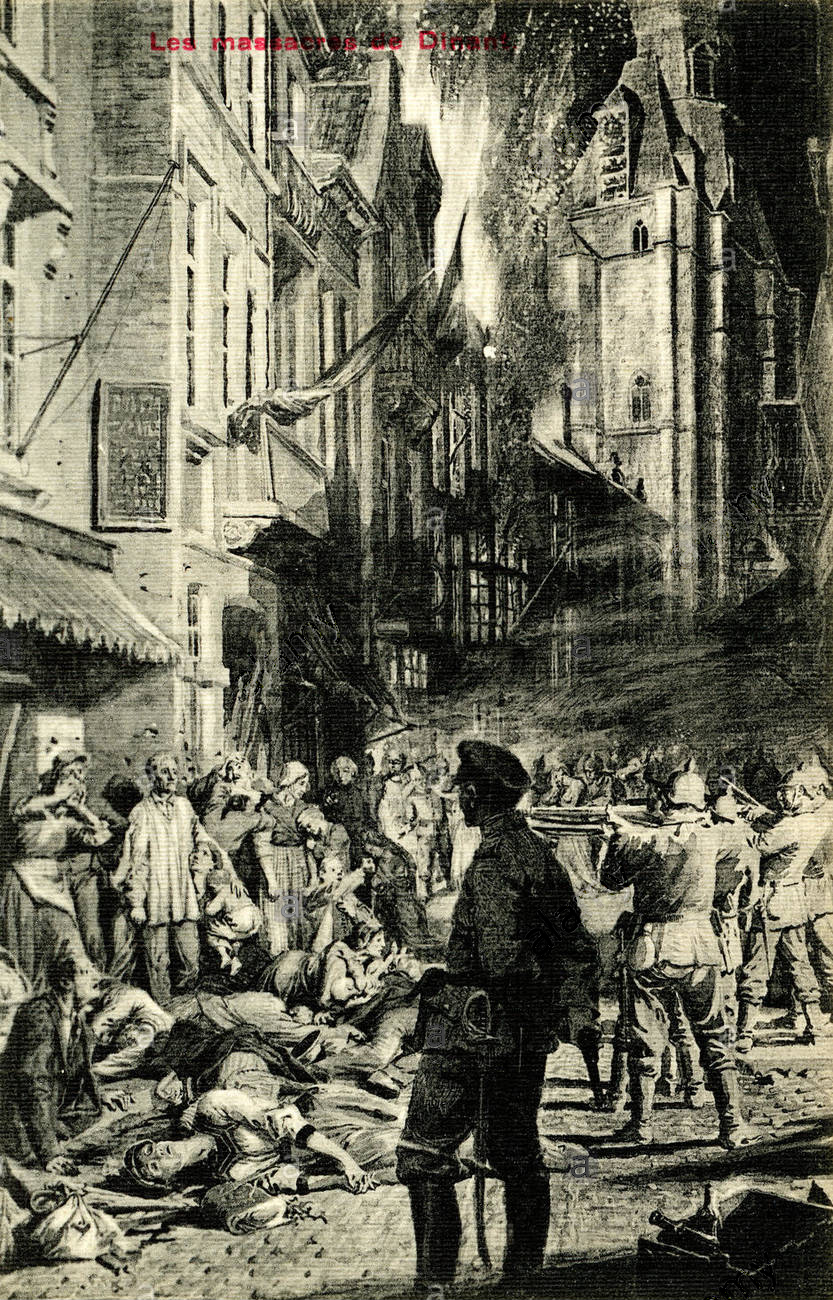
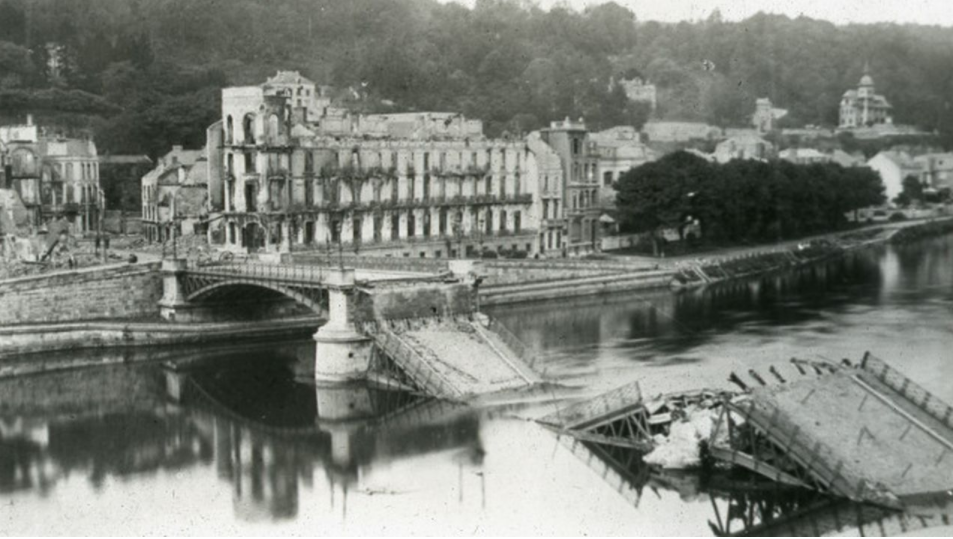
In may 1940 the westfront of WOII emerges and Dinant is again cardinal in the western charge of German military troops. This time the strategies of both military sides seem way more sophisticated, developed and blitz than during WOI, while the population flees the city very early remembering the massacre of WOI. The Germans only burn selected houses, to create mist. Then the eastern armies rage over regardless of nature zones and people's homes.
The Dinant region is bombed again four years later for the liberation. Three months later, in desperation, Germany tries to restart the Western front, again through Belgium, culminating into the Battle of the Bulge. When people are celebrating christmas Germany is finally scared away by British troops keeping a close watch on the bridges of Dinant. USA armies fight an important battle more to the southeast, in the Ardennes.
By 1950 Freyr has 44 routes. Around 1955, Pierre de Radzitzky opens a whole series of routes on the Mérinos. By 1957 there are 82 routes in Freyr. René Mailleux thinks back of Freyr then as a school of solidarity. A strict set of ethics already applies to climbing. Rappelling down is only allowed in case of an emergency.
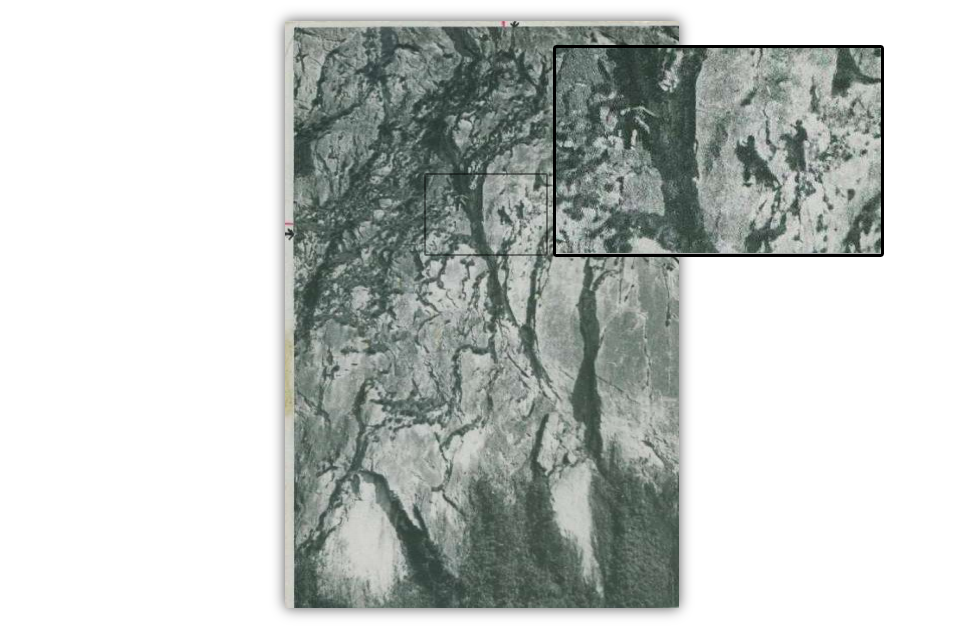
Traverse on the 120m Al'lègne multipitch.
After the technological innovations of WOII the climbing community lays her hands on the first dynamic ropes. By 1965 there are 259 routes in Freyr. Aid ('artif(iciel)') climbing surges and leaves its marks on the Freyr rocks. But not for long..
Mark Sebille collected great pictures and shows them here.
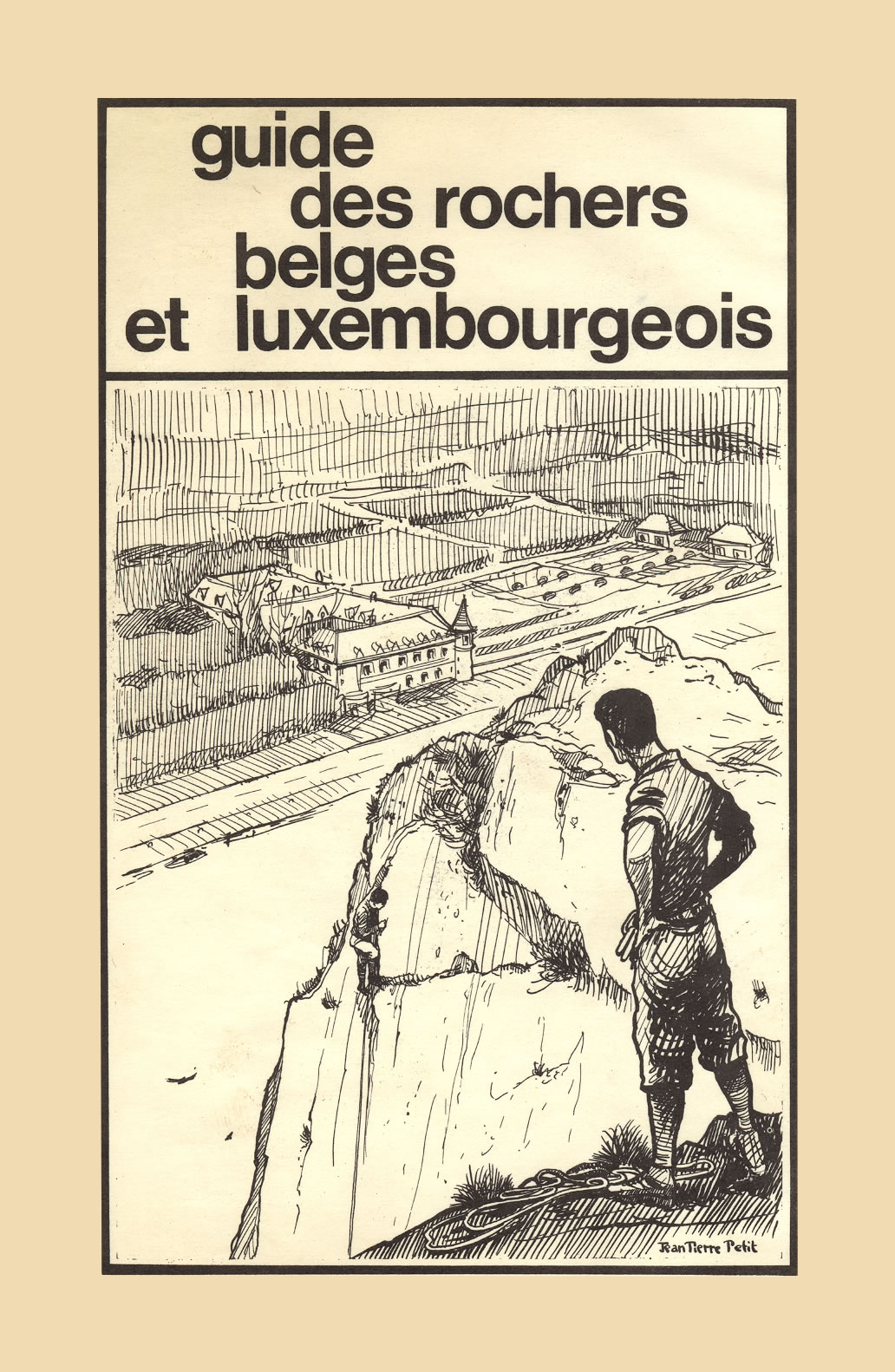
A 1966 CAB climbing guide (source).
A number of Freyr regulars will die over the years. 'Escalades au soleil de minuit' is a 1961-movie about a Belgian expedition to Greenland where 4 key Freyr figures find death, of which the free climber (avant la lettre) Jean Alzetta. Andre Capel dies in 1963 on the infamous Piz Badile. Around Freyr you'll find more crosses of old guests that found death to early.
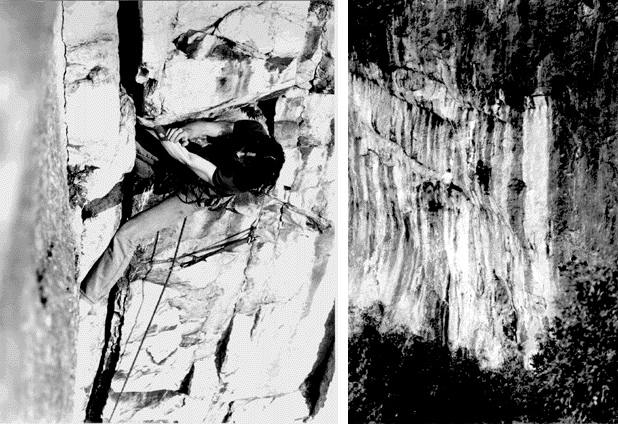
Al'lègne.
In the midst of the 1960's free climbing Claudio Barbier and Jean Bourgeois (you can still see him in Freyr sometimes) will spark a free climbing rage in Freyr (up-to-date hommage website by author D.Demeter). Steadily a free climbing movement actively contests aid climbing on gear. Youngsters revolt and worship the Elbsandsteiners, Dolomite warriors and Peak districters. At that time, leaving aid gear on the ground, a new generation overthrows locked-in traditions in Yosemite, the Gunks, Saussois(-sur-Yonne), Pfalz, Buoux, Smith Rock, Altmühltal (South of Frankenjura) and Freyr, sending pictures and stories over the world faster than ever.
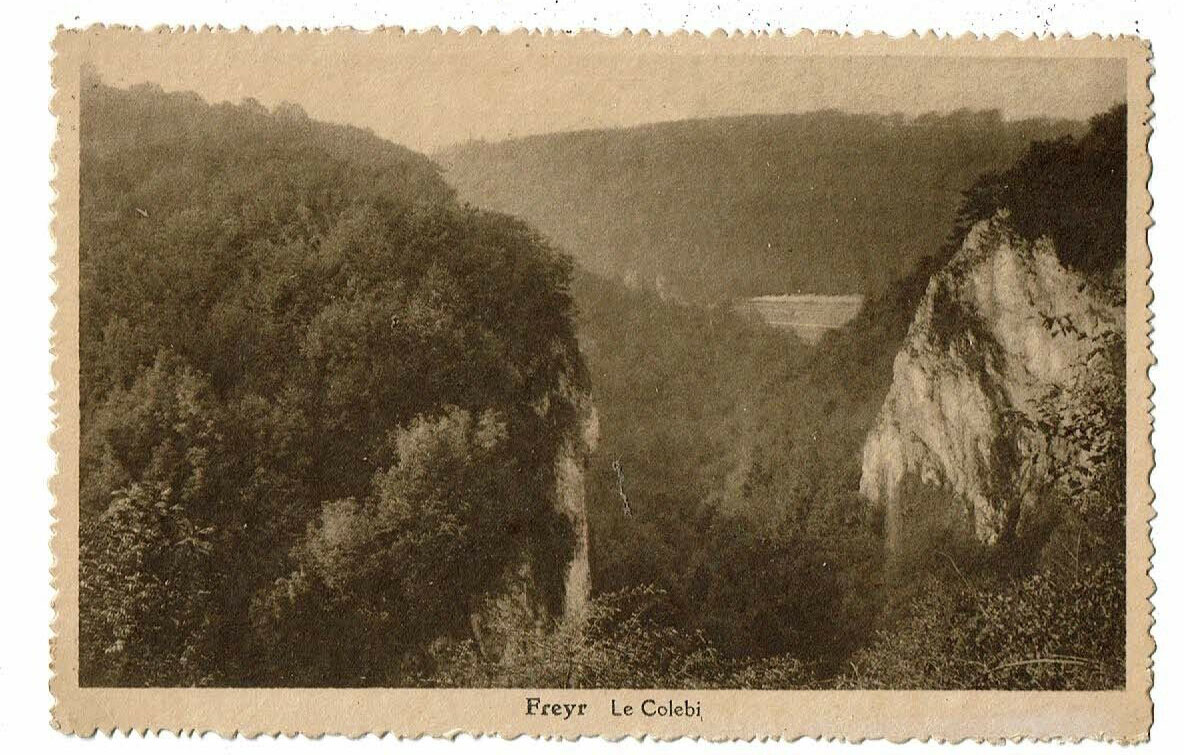
Around 1969, a serious threat hangs over Freyr: local businessmen have imagined creating a giant caravan site between the road, the Colébi and the rocks. With the help of various environmental protection associations, the Alpine Club will oppose the plans and succeed in convincing the minister to ban this project.
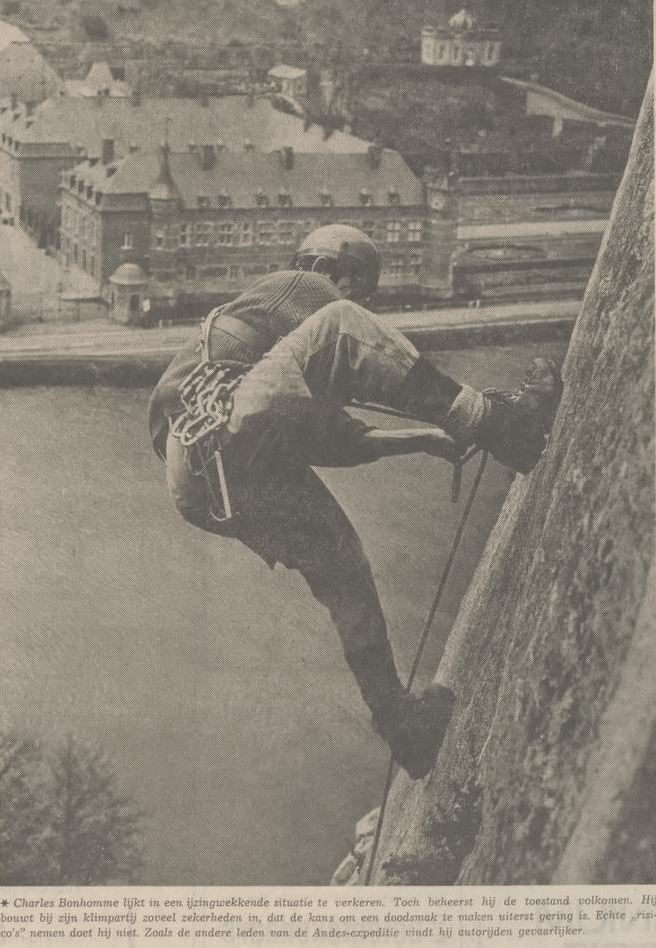
Photo from a newspaper in 1975 (source). Notice the alpinist boots. Sport climbers at the time rather wear EB-branded stiff rubber climbing shoes, until in 1982 finally sticky rubber climbing shoes are invented. (another one but owned by the CAB.)
After Claudio's accidental death in Yvoir in 1977, Freyr counts 298 routes and goes on as one of the world's key sites where the possibilities of difficult free climbing are further explored, led by figures like Arnould 't Kint, Pierre 'Pico' Masschelein, Isabelle Dorsimond, Jean-Marc Arnould, Philippe Lacroix, the Van Sint Jan brothers, Johan De Schepper and many more. Besides difficult sport climbing, Freyr also remains a key site to practice self-reliant, aware and quick advance in alpine rock terrain, explaining sparse bolting and rock that's polished like mirrors.
In 1981 Arnould 't Kint frees Boulevard du Vol, 13. Relying on present-day community grades, the Boulevard line is the first in Europe to be considered of the elusive 8th French difficulty grade. At the time in the US only two routes are climbed that will later be recognised as also being in these impossible new difficulty regions. Boulevard is visible on the photo on the left. Soon more lines will be tried and freed over the whole world and the flirts with climbing's impossibles will be brought to unknown levels.
The climbing community also loses: In 1978 on another Greenland expedition: Mon de Mayer, Dré Beuckelaers and Oscar D'Hollander. In 1982 Jean-Michel Stembert dies soloing Pichenibule (7b+) in Verdon. In 1987 Wim Smets is killed by an avalanche at Yerupaja in Peru. Frans Dekens is struck by lightning on a glacier and Renaat Muys later dies in Peru on an expedition.
From 1988 to 1993 the amount of routes increases from 367 to 521 (of which 32 unequipped). Touringcars from The Netherlands flood the place. Agreements between the climbing federations make climbing on the site a lot more sustainable again. Thanks. We hope the federations but also the climbers will continue efforts.
International guests over the years include Dave Graham (2003), Dave McLeod (2009) and more people invited by the Leuven University Alpinist Club LUAK.
From 2016 to 2020 former climbing champion Jeff Roba resides in a chalet that he had built from recycled materials (without permit and chance of permit) in a forest very close to Freyr.